James’s main complaint was chronic knee pain. He was able to do most of his activities, but his knee hurt, and the pain seemed to be increasing over the last few months.
James played sports when he was younger, and wanted to continue, but had cut back significantly due to his chronic knee pain. He could not remember a specific injury to his knee. He continued to hike, but could not run like he had previously.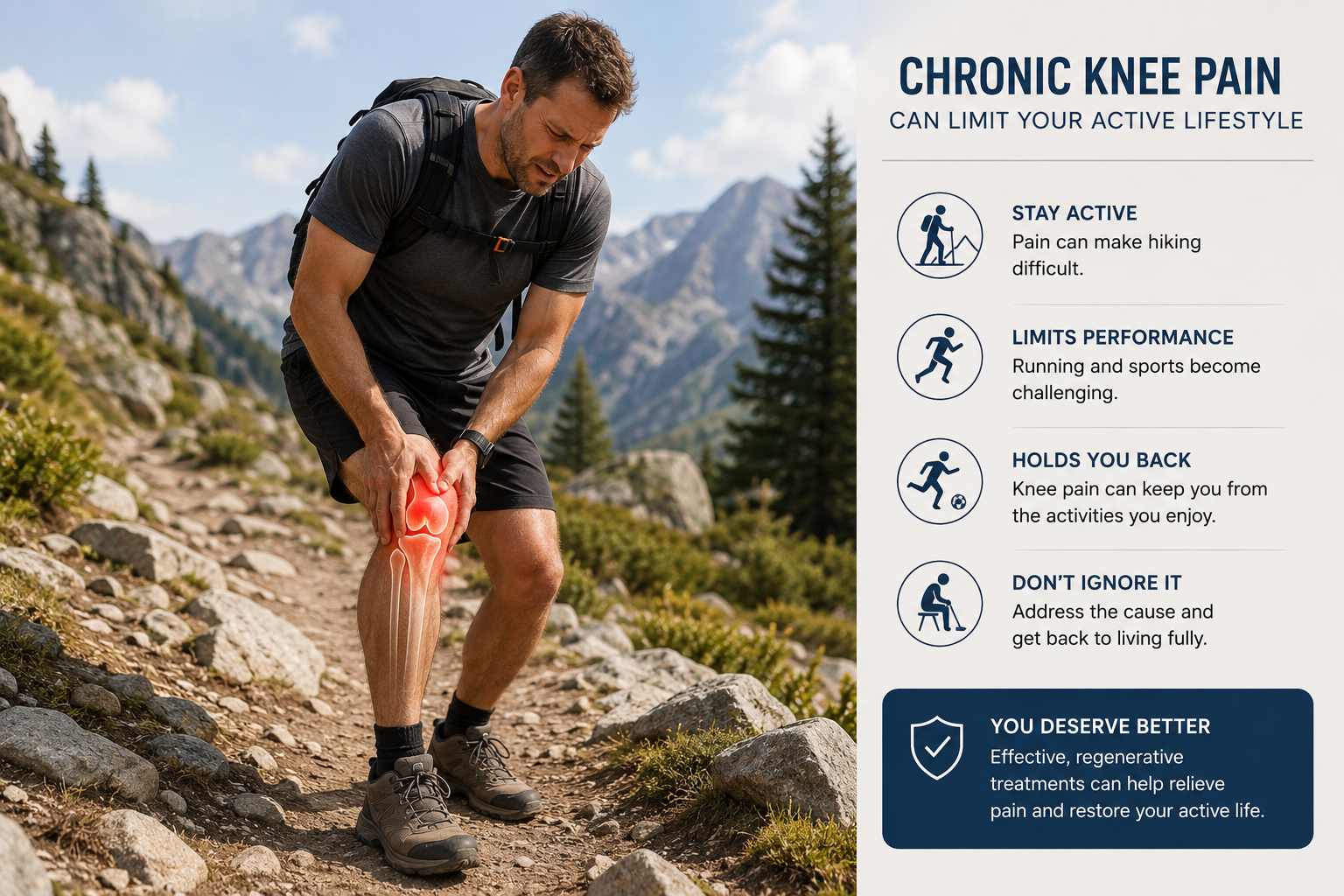
A realistic image of an active adult man experiencing knee pain while hiking or exercising, showing how chronic knee pain can interfere with an active lifestyle.
His physical exam was fairly unremarkable. There was no swelling, redness, or laxity in the ligaments. There was pain on palpation over the antero-medial joint line. This area is a common pain generator.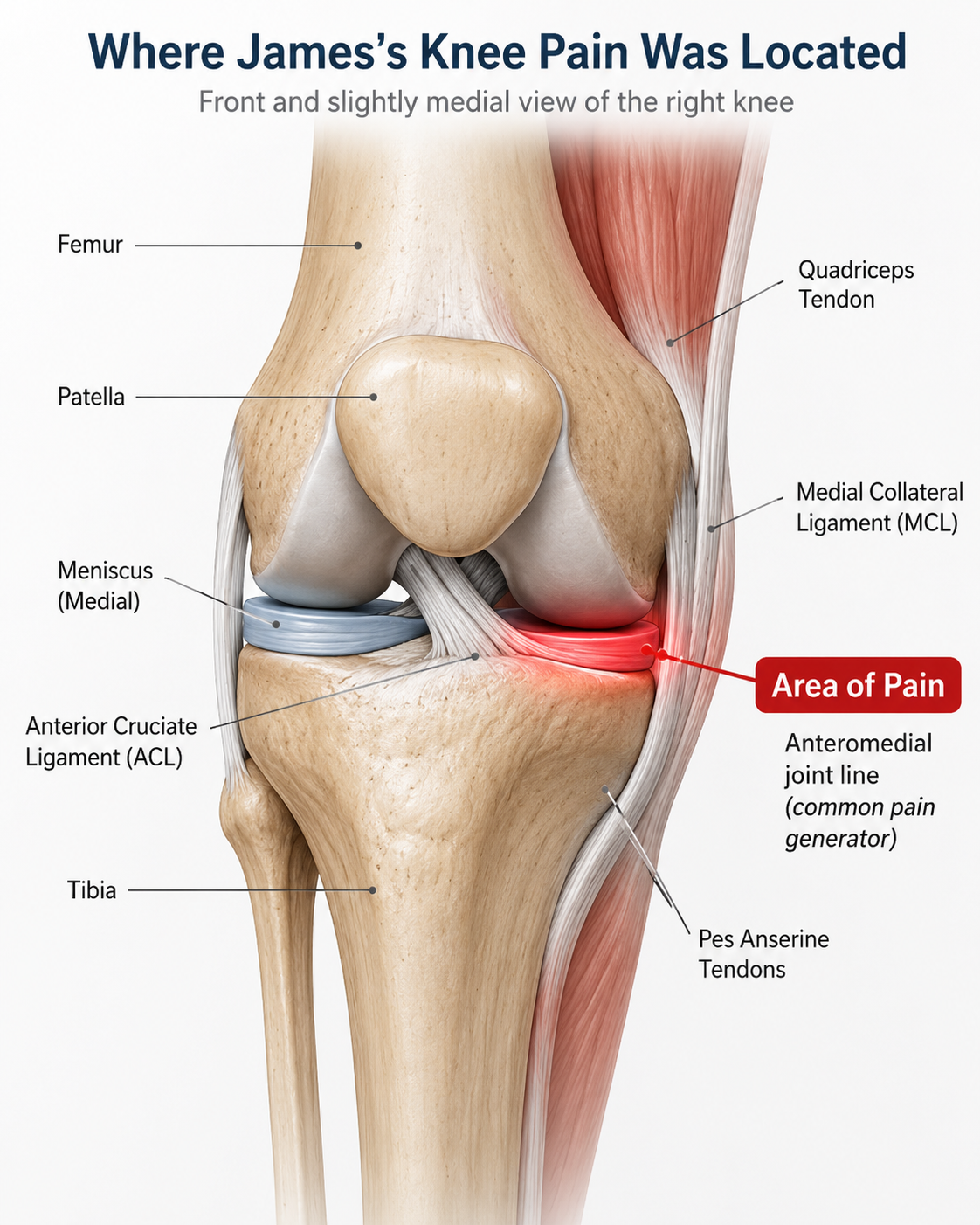
A clean medical anatomy graphic of the knee highlighting the anteromedial joint line and showing the specific area where James experienced tenderness and chronic knee pain.
An office examination using the ultrasound was unremarkable. X-ray of his knee was normal. In cases like these, MRI of the knee can be helpful, but after a discussion with James, we decided to move forward with treatment without the MRI.
For chronic knee pain there are several options, including knee replacement surgery, physical therapy, pain medications, and regenerative knee injections.
I don’t think any surgeon would recommend knee replacement surgery in an adult with normal radiographs. Pain medications can be helpful, but they usually are not curative.
After a discussion with James, we decided to give regenerative injections a try. In his case, we decided to use prolotherapy.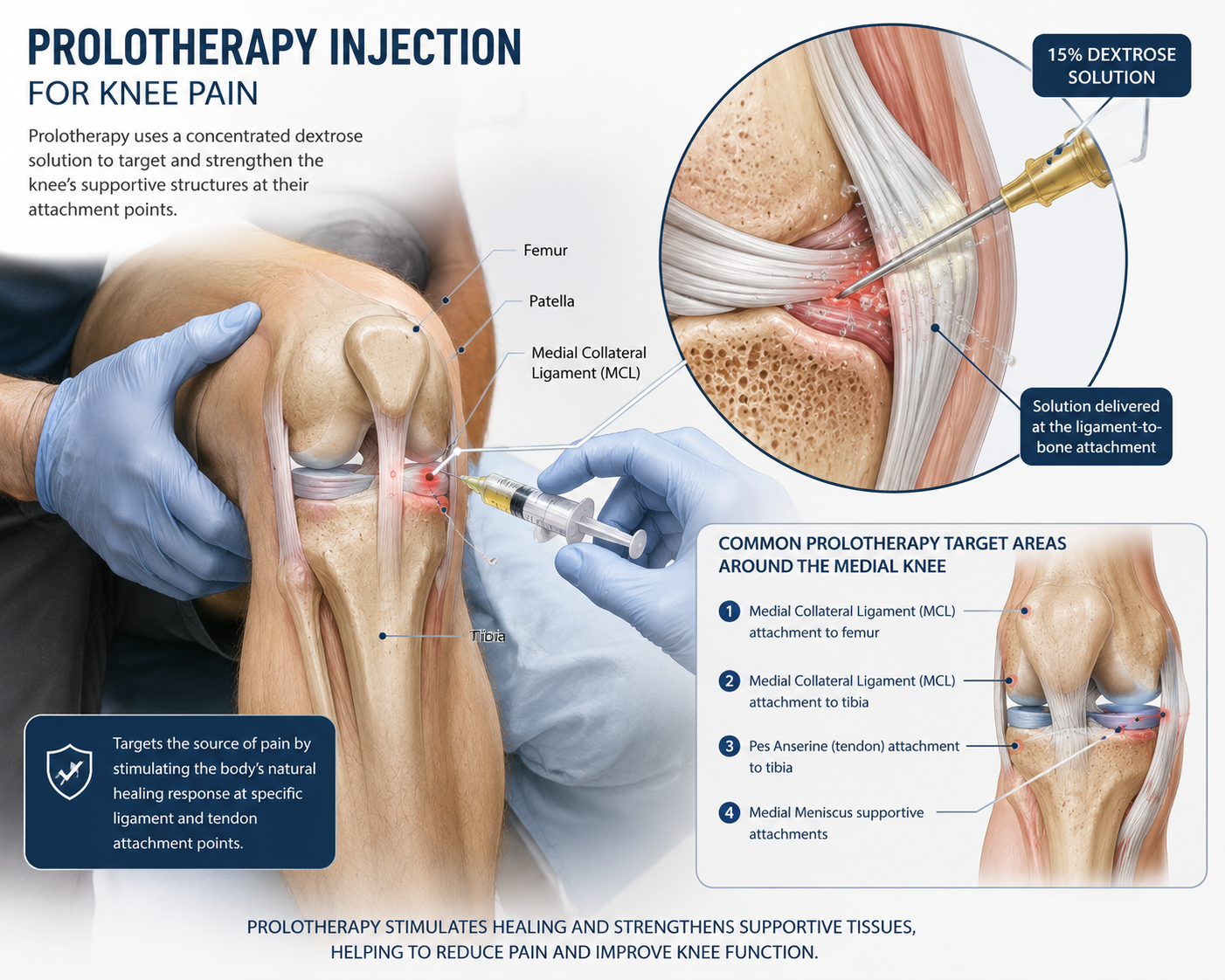
A professional medical illustration showing a prolotherapy injection being administered into targeted structures around the knee, with emphasis on ligament and tendon attachment points rather than an injection simply going into the center of the joint.
Prolotherapy is a system of regenerative injections where the painful area and the supportive structures of the knee are injected with a concentrated solution of sugar (15% dextrose). Very specific areas, where the ligaments attach to the bone are targeted.
The theory behind prolotherapy is to give a mild healing stimulus to a chronically injured area. The combination of the trauma from the needle, and the concentrated sugar stimulates the body to initiate a healing cascade.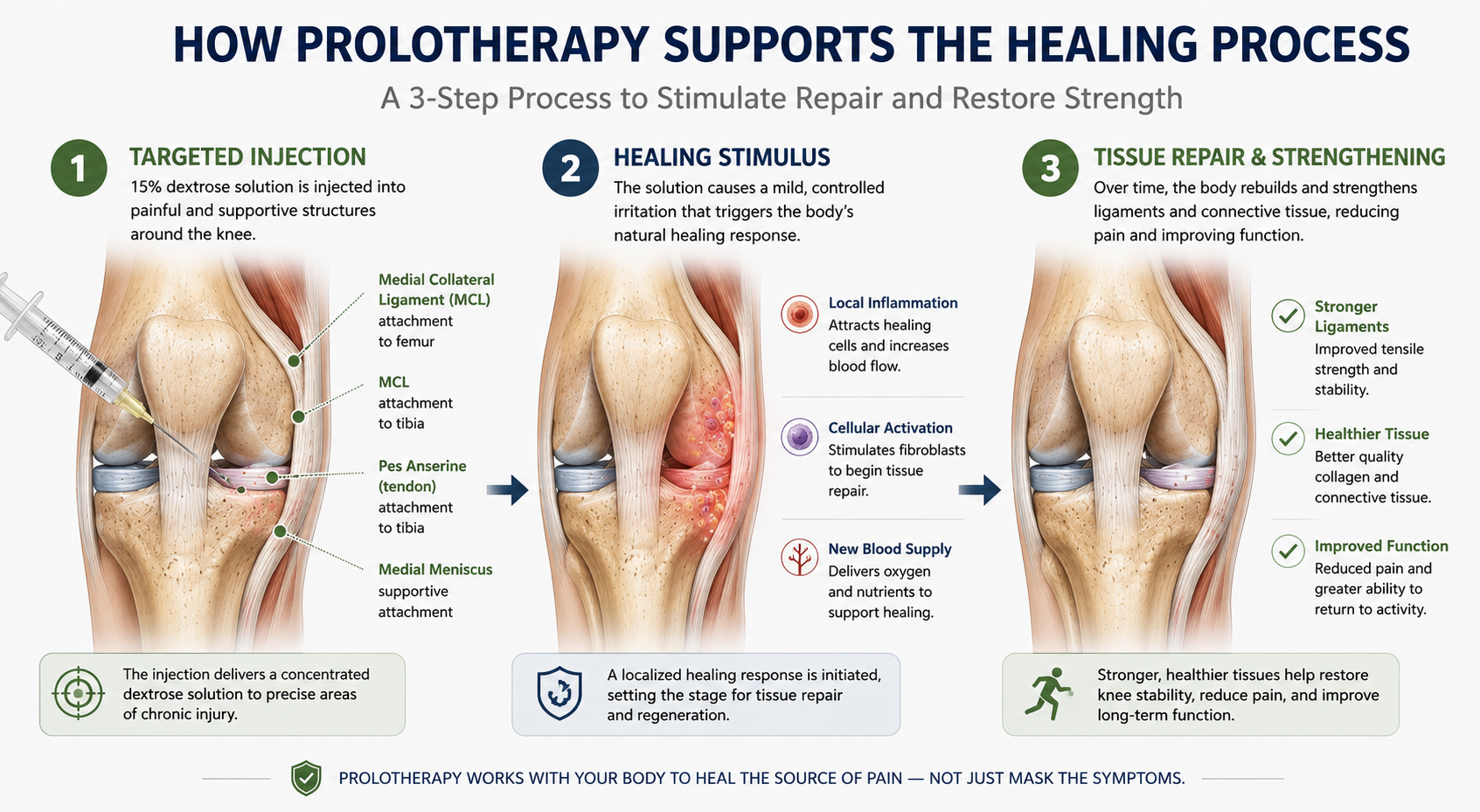
A simple three-step medical infographic showing a targeted dextrose prolotherapy injection, the body's localized healing response, and strengthening and repair of the treated knee structures.
In the literature, most practitioners recommend a series of 3-6 sessions of prolotherapy in order to get complete healing. However, in my experience it is remarkable how many people get completely better with a single session of prolotherapy.
In James’s case, I gave him a standard treatment of knee prolotherapy. Six weeks later I saw him in follow-up. His knee pain was completely gone! Several years of knee pain which had begun to limit his activities had completely resolved.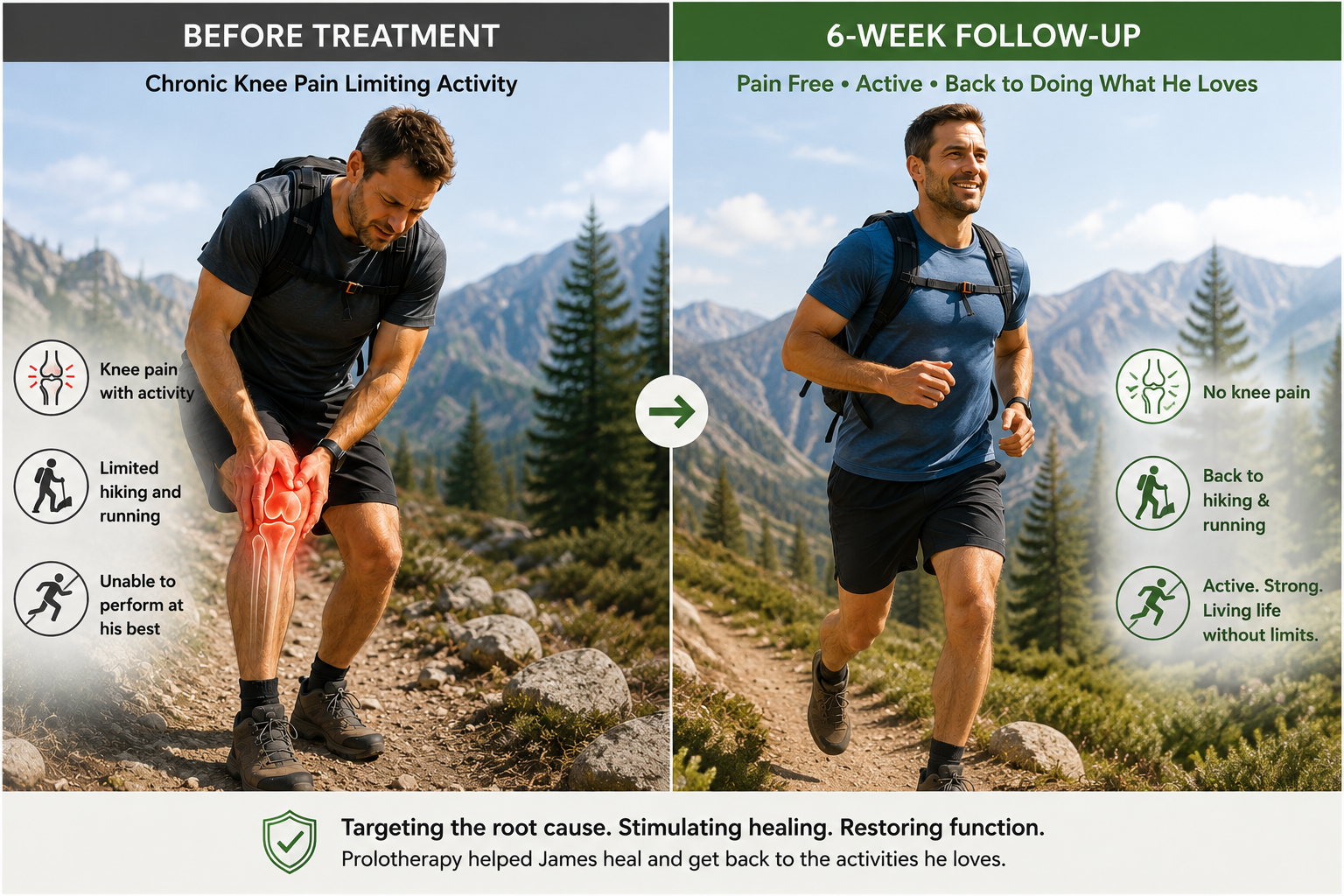
A realistic image of an adult man comfortably hiking or being active outdoors without visible knee discomfort, representing James returning to the activities that chronic knee pain had previously limited.
I continue to see James for medical care and follow up. It has now been several years since our prolotherapy treatment on his knee. The pain has not returned. He continues to be very grateful for the improvement in his life.
It is experiences like this that make working as a physician very satisfying.